
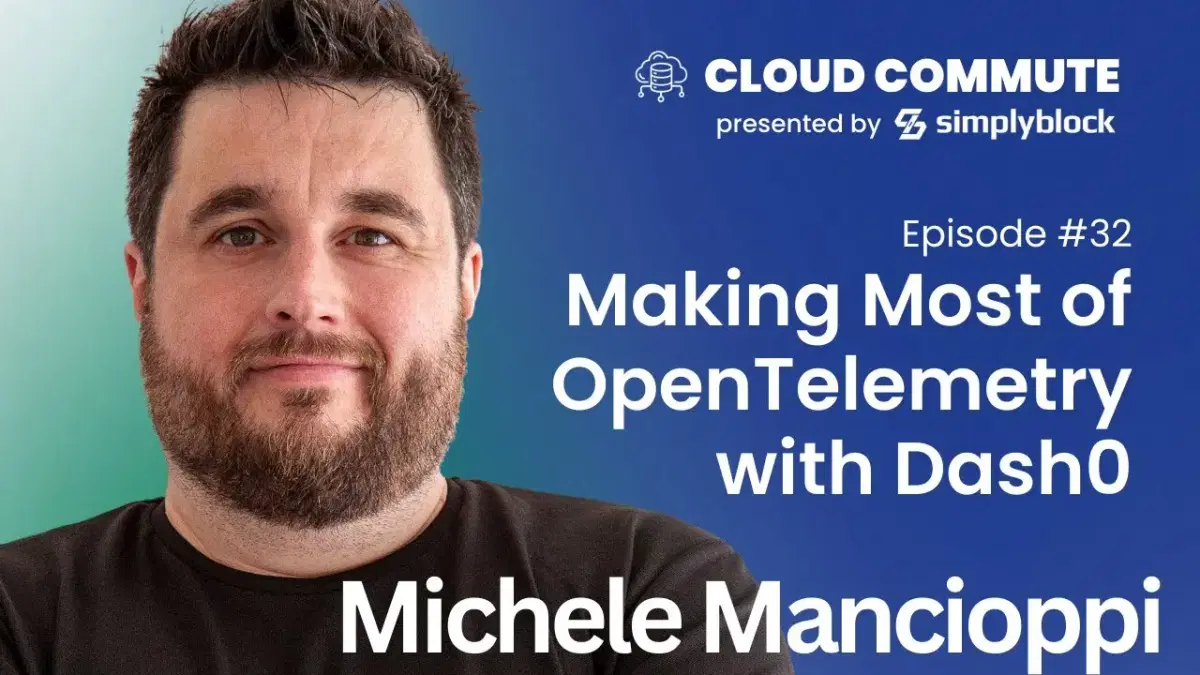
This week on Simplyblock’s Cloud Commute Podcast, host Chris Engelbert speaks with Michele Mancioppi, Head of Product at Dash0, about the evolving world of observability. They dive into how Dash0 is reshaping OpenTelemetry-native observability to deliver deep insights across distributed systems. If you’re interested in elevating observability in your infrastructure or understanding the power of OpenTelemetry in today’s data-driven environments, this episode is packed with expert insights.
This interview is part of the simplyblock Cloud Commute Podcast, available on Youtube, Spotify, iTunes/Apple Podcasts, and our show site.
Key Takeaways
What is Dash0, and how does it support OpenTelemetry for observability?
Michele describes Dash0 as an observability solution deeply integrated with OpenTelemetry, designed to handle complex telemetry data across distributed systems. Dash0 focuses on harnessing OpenTelemetry’s extensive metadata and correlation capabilities to improve user experience. By integrating directly with OpenTelemetry’s OTLP protocol, Dash0 allows seamless data ingestion, ensuring interoperability with various monitoring setups and leveraging OpenTelemetry’s correlations to offer context-rich insights.
How does OpenTelemetry enhance observability compared to traditional monitoring tools?
According to Michele, OpenTelemetry offers a high-quality framework for collecting varied telemetry signals, such as traces, logs, and metrics. Unlike traditional monitoring tools, OpenTelemetry’s standardized data structure enables deeper insight by correlating different signals across systems. This alignment makes it easier to troubleshoot distributed applications by offering context, allowing users to understand relationships between issues in ways previously impossible with standalone tools.
What is the role of a product manager in observability-focused projects, and how does technical expertise impact this role?
Michele emphasizes the need for technical expertise in observability product management. With a background in both engineering and product, he advocates for PMs to grasp the technical aspects of observability—enabling effective decision-making and communication with engineers. In observability projects, a technically knowledgeable PM can bridge the gap between development and business needs, ensuring product relevance and usability.
In addition to highlighting the key takeaways, it’s essential to provide deeper context and insights that enrich the listener’s understanding of the episode. By offering this added layer of information, we ensure that when you tune in, you’ll have a clearer grasp of the nuances behind the discussion. This approach enhances your engagement with the content and helps shed light on the reasoning and perspective behind the thoughtful questions posed by our host, Chris Engelbert. Ultimately, this allows for a more immersive and insightful listening experience.
Key Learnings
Why is context important in telemetry data, and how does it help in troubleshooting?
Context is crucial in telemetry because it enables users to interpret raw data effectively. Without context, metrics or logs are often just ambiguous values; context provides meaning by correlating events with relevant metadata, indicating where and when issues occur.
Simplyblock Insight: Contextualizing telemetry is essential in distributed systems, as it connects disparate signals into a coherent picture, enabling faster root cause analysis. By linking metrics, traces, and logs, context helps reduce incident response times and fosters proactive monitoring across microservices architectures.
What are the main differences between traces, metrics, and logs in observability?
Traces, metrics, and logs each play unique roles in observability: traces capture the path of a request across services, metrics provide quantitative data on system performance, and logs record events and errors in the system. Together, these signals provide a comprehensive view of system health and performance.
Simplyblock Insight: These three pillars of observability are most effective when used together. Traces offer insights into user transactions, metrics reveal performance trends, and logs provide detailed error records. Balancing these components enables organizations to monitor systems effectively, troubleshoot issues, and maintain reliable service delivery.
How can organizations get started with Dash0 in Kubernetes environments?
aDash0 simplifies integration with Kubernetes, providing first-party operators to gather telemetry data without manual configuration. Dash0 captures traces, metrics, and logs from Kubernetes clusters, making it straightforward for organizations to deploy and start collecting OpenTelemetry data.
Simplyblock Insight: Kubernetes environments benefit from the observability Dash0 offers, as it provides comprehensive insights across nodes and containers. By integrating with Kubernetes, Dash0 allows teams to monitor containerized applications in real-time, enhancing reliability and optimizing resource utilization.
Additional Nugget of Information
What role do Large Language Models (LLMs) play in observability, and are there any current limitations?
LLMs hold promise for observability by helping translate complex system data into understandable summaries. While LLMs are helpful in interpreting telemetry data, their accuracy and tendency to hallucinate results present current challenges. Organizations are exploring ways to use LLMs for telemetry summarization and anomaly detection, yet caution is advised.
Conclusion
In this conversation, Michele Mancioppi highlights Dash0’s deep integration with OpenTelemetry and how it enables powerful, context-rich observability across distributed systems. Dash0’s design makes it easy to gather comprehensive telemetry data while offering actionable insights and simplifying the observability setup in complex environments. Michele also underscores the importance of technical expertise in observability product management, which helps bridge the gap between engineering and business needs.
This discussion clarifies how OpenTelemetry is redefining observability and explores the future of context-driven data monitoring. Whether you're managing microservices or transitioning to cloud-native applications, tools like Dash0 and frameworks like OpenTelemetry will be essential in ensuring resilient, scalable systems.