When I moved to Spain, I didn't know any Spanish and I learned Spanish quite quickly. I always felt like I learned a lot from my stu more for my students probably than they learned from me. But it was a great way to get a feel for the country that I was living in, the place that I was living in, and also to understand better how information is processed and transmitted.
As he said, don't get angry at somebody because A person doesn't understand because it's most probably you not explaining it right. If a person doesn't understand like five times in, either you might want to exchange the teacher or the student, but that, that is a different thing.
The idea with KubeFM is that our guests are folks that have Already taken the time to write an article.
So they've organized their thoughts, they've put some structure into it, and what we do is we dive deeper to understand why did you make the choices that you made? What was it that was going on in your head that why you decided to pay this or that you know better than anybody. There are always gonna be trade-offs.
Hello, everyone. Welcome back to this week's episode of Simpleblock's Cloud Commute Podcast. This week will be very special. I have a guest that is not like the typical kind of guest we always had.
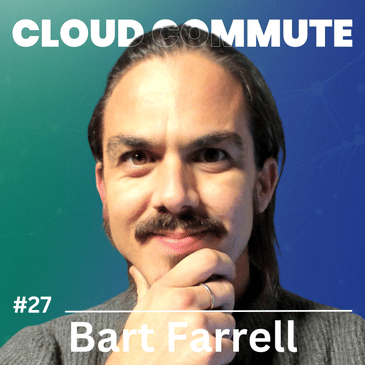
You know, normally we always have like a guest working for a specific company, talking about their product. This week will be very, very special. Bart thank you very much for being here and maybe just give us a quick introduction on who you are, why you are special here.
Well, first of all, thanks so much for having me. Great to be on the podcast. And from looking at the other guests that you've had, I think it's fair to say that this probably will be a little bit of a different conversation given my role. My name is Bart Farrell. I'm originally from the United States, but I've been living in Spain for the last 14 years, and I've been a freelancer for around the last seven years and working in the cloud native ecosystem for the last four. Very much focused on content creation and event organization.
I run a podcast called KubeFM, which is part of LearnK8s. Folks might be familiar with that. I've been a CNCF ambassador for the last three years, and very active in the community in all ways possible. Really like interacting and learning from very smart people such as yourself. We got connected in the Postgres world, probably have to talk about that a little bit more in detail.
But always excited to, to learn about new ideas, all the things that are going on in a very fast paced ecosystem in which we happen to work.
All right, cool. Yeah. You already mentioned, we, we know each other actually not from the Postgres world, which is kind of weird, but from-
not from the Kubernetes world, but from the Postgres world, that's where we met first time, two years ago, last year, something, PG Ibiza.
So for everyone, whoever wanted to go to a Postgres conference on Ibiza, there's your chance. It will be in a few weeks. September or something?
Yep. September 9th to 11th. Yeah.
Oh, there, there you go. You know better. I think you're actually part of the organizing committee, aren't you?
Correct. Correct.
There you go. Hey, you do so much stuff in the community. It's absolutely incredible. So yeah, what is the connection to the Postgres world? I think we come back to the Kubernetes world in a second then.
Very good. So I think the connection to the Postgres world, if I could summarize it is to be fearless.
So, in 2020, I had the opportunity to start leading the data on Kubernetes community, and when I started, there were 120 people in Slack and I went alphabetically and just started introducing myself. Well, it turned out that someone's name started with A, his name is Alvaro Hernandez. He's based in Spain, and we started talking.
And so from there, we became friends and he's very active in the Postgres community, has been for quite some time. And so he was in the data on Kubernetes community to discuss the topic of Postgres op, Postgres operators in Kubernetes. And then I found out that he also organized his own events. As you mentioned, it's in Ibiza.
They took some years off because of the pandemic. But when the opportunity came up last year to get on the organization team and help out, emceeing the event and promoting it, I said, absolutely. Of course, I'd like to go to Ibiza. I've lived in Spain for quite some time, but I never traveled there.
And we had a great time last year, and we're gearing up for this year's event. You know, with Postgres in particular as well, you know, being the battle tested, database that it is, it's been used all over the world, so many different cases. And now also as well, seeing a lot of the work going around, when it comes to extensions on Postgres, it's great to see the community that's behind that, all the different ideas, seeing people from all over the world, people that attended last year, all the way from Indonesia to different countries in Europe. Also some people from North America. And this year is looking quite good too.
So that's kind of how I got connected to Postgres.
All right. Fair enough. You mentioned Alvaro. And I think I had Alvaro on the podcast in March or something. I'll link the episode in the show notes. It was actually quite nice episode specifically because he said he's very big into looking into making operators for Kubernetes for the Postgres world. And that was the main topic for him basically talking about StackRest and his own company, Ongress.
Okay. So, I see you're big into communities where the ecosystem is vast. That could be Kubernetes, but it could also be Postgres. Is there anything else we need to know about you?
That's a good-
that's a good question. I think also, you know, being, finding, you know, finding your niche in these spaces, in the beginning, you know, it took some time, particularly because I come from a non technical background, so it was quite daunting at first. But I can't stress enough, you know, how welcoming everyone's been and how that hasn't been a problem, and really it's been a question of, you know, what are the other ways that you can contribute?
So, in different ways, you know, I speak multiple languages. I speak Spanish because I've been living in Spain for quite some time, so that's a way to interact with local communities in Spain. Also working with, I worked as a teacher in the past. And so, you know, when it comes to presenting, giving presentations or things that most people hate doing in terms of public speaking, it's an area where I find myself quite comfortable and also helping young people getting involved in the cloud native ecosystem.
Having done that in the teaching world as well, there's a very healthy, healthy overlap between the two. So, yeah, I've definitely touched on a lot of different areas. But I've been able to combine them, whether it's been with music, whether it's been with creating videos, I'm also a big hip hop fan.
So for the Data on Kubernetes community, I wrote a lot of raps about things ranging from Postgres operators, all the way down to, you know, cybersecurity. You name it. I probably wrote a rap about it sometime before the days of ChatGPT, I'd like to add. But I've really been lucky that, like I said, that I've been part of such welcoming committees, communities where everyone is interested to see what other people can provide. And there's no question that's too basic. Being curious is a great way to get conversations started.
Yeah. So you said you worked as a teacher before. Elaborate on that. What kind of teaching?
Good question. So when I moved to Spain, I didn't know any Spanish and I learned Spanish quite quickly. But in the meantime, the first job that I could get was teaching English.
And so that meant teaching kids all the way down to the age of eights, to adults, you know, in their sixties. And so working at companies, teaching people that work for the government, teaching engineers, teaching, teaching teachers. And I felt that, I always felt like I learned a lot from my, more from my students probably than they learned from me, but it was a great way to get a feel for the country that I was living in, the place that I was living in, and also to understand better, you know, how information is processed and transmitted.
They say, you know, that If you study the idea of teaching, it's basically knowledge of your subject and then your ability to transmit it. And so getting angry at students for not understanding something is like, well, perhaps maybe I'm not explaining it the best way possible. And so being flexible and adapting to different learning styles, I learned a lot through that process.
And also through having to teach teenagers a few times, I learned how to be patient and focus on objectives. I think also it doesn't matter whether it's, you know, whether it's English or whether it's Postgres, the best environments, you know, in terms of teaching is when your students teach each other, when you create an environment where they're able to share knowledge with each other, and you're just more of a facilitator.
So yeah. So I did that for about four years. And at the same time, then I started, helping companies that would be giving presentations internationally. We prepare in that. So focusing more on public speaking and I've continued to do that also with the entrepreneurship, entrepreneurial community in Bilbao in the north of Spain where I live.
And that's also carried over into the cloud native world where I work as a consultant. So every CEO, every CTO needs to go out there and be able to explain their ideas and needs to be able to do so in a short period of time that's practical, focusing on the value of what it is that they're offering.
Particularly considering that in the world in which we work, we're talking about things that are generally not tangible. So how do you make something visual? How do you make it come to life? And particularly with all the competition that's out there, how can you really double down on, you know, the pain points that the end users might be facing, so that they see that it's actually going to be providing something but the current alternatives simply don't.
That is interesting because as you said, you're working mostly in content creation these days for the cloud native community or the Kubernetes community most specifically. And, as you said, I think teaching people will give you a good insight into how to get a specific topic across. How do I have to explain stuff?
And as you said, don't get angry at somebody because the person doesn't understand because it's most probably you not explaining it right. I mean, if the person doesn't understand like five times in either, you might want to exchange the teacher or the student, but that is a different thing.
I mean, I had it in the past, but literally, a second person came in, just phrased it slightly different and it literally made click for the person. So sometimes it is this like, okay, I'm just not the right person. So from the CNCF community itself, you're traveling a lot. You're doing your own podcast.
You're doing these shorts, short interviews, specifically for the Kubertanis, that was like a massive series of shorts. How many did you record for that?
About 30 and actually still planning on doing more throughout the rest of the year. But the core focus was, you know, since June was the celebration month, but then we thought like, you know, why stop the conversation there?
We got a lot of interesting feedback from those interviews. And a lot of-
we asked two simple questions. So it was, what's your least favorite feature on Kubernetes? And so we got lots of different things. Some people still actually writing stateful workloads was something that was mentioned. So, you know, the database problem, you know, working with data is still tricky for a lot of people. But by far, the one that seemed to stand out the most was networking and, you know, managing network policies on Kubernetes seemed to be very frustrating for a lot of people.
And the other question that we asked was, you know, the future. What do they imagine will happen in the next 10 years of Kubernetes? So a fair amount of people responded with the idea that kubernetes becomes a platform for creating other platforms. Kelsey Hightower is referred to that it will, you know, simply blend into the background and become a lot more boring.
If we look at, you know, the history of Linux, what can that teach us about where Kubernetes will be headed as being a well adopted and accepted, you know, technology that across the world is just, you know, de facto standard, which it, you know, de facto standard, we can say for contained orchestration is already there. But continuing to move further in its adoption, becoming less of a wild west and more something that's just very much standardized.
So those were good. Then the main episodes that we do for KubeFM, we find engineers that have written blogs and we bring those blogs to life through a conversation. And so going back to the idea of teaching is that everybody learns in different ways. So for example, in your case, what works best for you to learn?
Do you watch YouTube videos? Do you read blogs? Do you read books? What's your go to resource?
I started programming when I was like 10 or 11 years old. So at that point in time, it was all books and trial and error basically, right? I mean, there wasn't a lot of stuff around it. I'm probably older than most people expect. So that was like 30 years ago, just for the ones that really wonder. YouTube was not a real thing at that time. Not even the beginnings. These days, I still think the like trial and error works best, in terms of like, that you best understand how stuff works and why it's probably doesn't work.
But I think to be fair, most of the things is probably like YouTube videos, and stuff like that. I have a good chunk of books. It's very, very hard to read books these days. I'm still not a TikTok guy, but I'm still not, still not on TikTok, but youTube videos or in general, like video courses, I think are the current like way to go.
Okay. Oh, that's great. In this case, you know, with-
And like you said, whether it's attention spans, you know, whether it's the influence of TikTok, whether it's the influence of, you know, YouTube Shorts, et cetera, et cetera. A lot of times you've got to be like, I want a very specific piece of knowledge, give it to me in the shortest period of time possible.
Like I said, everybody learns differently. So, but the idea with KubeFM is that the-
our guests are folks that have already taken the time to write an article. So they've organized their thoughts. They've put some structure into it. And what we do is we dive deeper to understand why did you make the choices that you made?
What was it that was going on in your head that why you decided to favor this or that? You know better than anybody. There are always going to be trade offs. If I use this database or that database, what am I getting? What am I gaining? What am I losing? We're talking about, you know, tools in the CNCF ecosystem.
If I use Flux as opposed to Argo, are any of the trade offs there? Is it a question of maturity? Is it a question of my use case? Is it a question of the community backing it? In some cases with CNCF projects, one could be sandboxed, one could be graduated. Then we can even talk about, you know, open source versus, you know, not like all the different things that are going to go into that.
So the conversation is designed around, you know, helping our audience understand the decision making process that the guests went through. A lot of times as well to, you know, having, you know, sort of horror story situations of when something went wrong, this is what I did. So let's face it, things are going to go wrong.
There are going to be fires in production. There are going to be outages. Things are going to go down. you're going to have to deal with that. So how do you-
so part of it is the-
we can say the emotional intelligence side of it of keeping calm. Skills that are not often, you know, taught, let's say in universities or, you know, in every context.
So combining those skills with then the more technical ones, that's kind of what we seek to do. And once again, with the idea of educating people of saying, look, you're possibly going to be in this situation. If you are, this is how I handle it. You may decide to handle it differently. And so doing that with a technical focus and it's always vendor neutral content.
it's just engineers helping out other engineers. That's the idea.
I mean, there, that, that is a good point, right? I mean, there's a reason why, these like lessons learned, best practices, whatever you want to call those talks are so big at conferences because it is like the best content you could probably generate in the sense of like, okay, why did I do something?
Or what was the, as you said, what was the decision making? What was the thought process behind that? And I think those thought process in itself, like evaluating certain things and making a decision why stuff works or doesn't work or would not work in your case. I think that is the interesting thing.
And the other thing you mentioned is that stuff will always break. And that is a good point, right? It's important to make people aware of that. In the past, I did talks on fault tolerance and that it is always a trade off between how much money do I want to spend and how much money do I lose if my system is down.
And right. there is no way to build like a hundred percent fault tolerant failover system. You will always have issues. The question is how much money do I lose per second, if I'm down? And what is the trade off I have to put in, in money to make it not happen? But because you said, one of the questions of your KubeFM podcast is like, what's your least favorite featuring in Kubernetes?
Let's flip the ties and what's yours?
Oh, I would say, so I would say it was, that's a great question. And what I would say, and I do agree, this was mentioned by a couple of people, is the vast complexity just to get started with Kubernetes. I think that it's still something. And as a CNCF ambassador, it's something that I look forward to working on with other ambassadors so that not just for non technical people, but so that the process is less overwhelming. Because you see like plenty of memes where it's all right, you know, you imagine you're on the sort of stairway to heaven towards, you know, the light, the guiding light of shining light of Kubernetes.
But then, you know, that stairway collapses and you fall into a hell of all these different kinds of technologies that you have to learn. To understand this, you have to understand that. And I think that's a process that a lot of people go through, which is why that learning curve is so quite steep. And inside the ecosystem, I think we get the feeling that you're going to walk down the street and you ask anybody what Kubernetes is, and they're going to have a perfect answer for you. And it's simply not the case, you know, it's a-
and maybe it's because of living in Spain where the adoption, you know, is a couple of years behind, if we look at the US and we look at other countries in Europe. But I think, you know, you talk to a lot of folks out there that are still running on very much, you know, monolithic legacy systems, and when you talk about Kubernetes, they know that they want to make the jump. They know that they want to do it. But what's the first step? How can that be easier? So I would say that as someone that really struggled, particularly going in directly into a sort of even more niche area through the data on Kubernetes community, because running databases on Kubernetes for a lot of people still sounds like crazy science fiction,
that was particularly challenging for me and that was quite painful. But through the patience and kindness and guidance of folks like Alvaro and lots of other people that I've met along the way, that made my journey less painful. It was-
it's been easier. I guess you can kind of say it's the sort of, you know, it takes a village to raise a child.
And I was that child and very, very much still in that child. So I would say, yeah, the complexity of getting started. I'm not discounting the mass amount of work that's been done on the cloud native glossary. There's been a lot of initiatives that have gone, that people are still putting a lot of work into.
But I feel like a fair amount of it still assumes a certain, a baseline that for me is quite high. But once again, as a non technical practitioner, it's only natural that it seems that way. So yeah, I would definitely, I would say that.
I think that makes sense. I mean, I'm coming from a very technical background. As I said, I started programming like super, super early and I still found the get first steps in into the Kubernetes world kind of complicated. So I get what you're saying. And the other thing that I personally think is, and that goes for any kind of abstraction layer, which Kubernetes from my perspective is, we call it orchestration, but in general, it's an operating system abstraction.
Everything is awesome until it breaks. If it breaks and you have no idea why, try to find it. Good luck. That is my personal biggest issue right now. We used it in my own startup and it was awesome when it worked. But the few times where you had an issue and it all didn't make sense,
and then that is where also the ecosystem comes in, right? Then you have like, as you said, Flux, Argo CD, You, you might have some, some service mash or whatever. And those things all just make it more complicated, unfortunately. They just make the learning curve even steeper than it has to be.
But apart from that, yes, Kubernetes is really good. I think one of the main benefits is that, and we have the same thing with Docker in the beginning, if you run Kubernetes, like even Minikube or K3S or something on your machine as a developer, it still brings you closer to production.
Right? This like, as a developer, like I made the commit, now it's the operations, the operating, team's problem. That is not a thing anymore. And it makes it much harder to find out why certain things don't work, or why they break in production and Kubernetes makes that much easier from my perspective.
We already crossed for 20 minutes mark. I can't believe. Let me see, but there's most probably, one, well, there was certainly one more thing that I wanted to bring up. Oh, right. The, databases on Kubernetes and in general stateful workloads on Kubernetes. It's a very good point.
I mean, with Simplyblock, we're in the same world. We believe databases belong on Kubernetes, at least the ones that are mission critical. But we see the same problems. We see a lot of people facing us like, no, stateful workloads are not, or Kubernetes is not designed for that. Like 10 years ago, or like five years ago, I would have agreed. Maybe not 10 years ago.
But five years ago, ago, I would have still agreed with you. But a lot of stuff changed. The CSI driver interface is absolutely incredible. For people that probably don't know, the CSI is the container storage interface. That thing is inherently designed for stateful workloads. Otherwise it wouldn't make any sense, right. so I think that is a very good point. And the data on Kubernetes community is a big step forward, making sure that people understand that. We haven't joined yet, but it's on our list to do still.
I'm no longer leading it, but there are some really talented folks that are interacting there and, you know, there's always presence at KubeCon.
I think also it goes back to the pain point, right, is that when in doubt, if you're struggling with something, find a community, you know, make community part of the solution. And so whether it's databases on Kubernetes, or it happens to be any other technology, there are other people out there that have probably gone through something similar, leverage that.
Yeah. For us, I started joining the CsI or the special integrist group, Storage Calls, a while ago, and then trying to be a little bit more active. Because the-
It goes both ways, right? You're leveraging the community, but that means y'all should, should give back to the community as well.
All right. And because of the 20 minute mark, last question, the question I always ask, well, that I always ask people, what do you see in the future? What do you think is like the next big thing, in your case, kubernetes, VCNCF, databases, data on Kubernetes, AI? Whatever you can think of.
That's great. I mean, from the last KubeCon. And particularly having, you know, when I was, running the data on Kubernetes community, we were talking about AI and ML workloads becoming more of a part on there. There's a great book by, Patrick McFadden and Jeffrey Carpenter about managing stateful data on Kubernetes, sort of Riley book that they wrote.
And they do talk about those workloads at the time, not only at the time that the book was written, but it was just seeing that, Oh, that's kind of further up the stack. Now, perhaps it's because of AI hype waves. Well, I would say there's a significant portion of that that is related to AI hype waves, but that the cloud native world feels like, Oh, we can't miss the boat, you know, we got to catch up.
We want to make sure that we're on top of this. We saw a lot of this in the last KubeCon. And so what I would kind of, you know, ask you, and also I want to hear more from platform engineers, SREs that are out there, how much are they using AI in their day to day work and, you know, in the sense of what value is really being provided.
Earlier this year, I attended an event in the UK where they spoke a lot about how many, you know, startups are really we can say running AI, you know, doing AI legitimately on their own, rather than just running everything back to open AI. I want to see where this can actually move forward in practical terms, or is there and is it still, is there a lot more time that's needed for these two worlds to come together?
I think that's, it's certainly a question that came up a lot. And I'm not seeing that many concrete answers yet, so it's a question that I'm going to keep asking. so I don't know if you have any thoughts on that, or it's a conversation that we can continue in the future.
I think it is a conversation that needs to continue.
I'm pretty much on par with your opinion. I personall don't believe that every single tool we use needs an AI agent or any AI feature in general. And I think that is part of the hype train you just mentioned. It, I guess it will, like slow down at some point. And, you know, only the use cases that are valid will stay.
But apart from that, I think it's interesting. And because you earlier asked like how I learn, I literally just published yesterday, a blog post on image recognition with neural networks. And I literally knew nothing about it except for it somehow works. And I literally used YouTube videos and blog posts, trying to figure out how that stuff worked.
I was-
it was quite an interesting thing from the idea of like ChatGPT or CloudAI or whatever. I like to use those to not start on a blank page, not generating the necessary content, because I think it's not a good idea to ask an AI tool or an LLM tool for its knowledge, if you can't pass it in at least, if you don't pass it in content. But I think it's great to generate an outline, like what are the interesting topics you could, you could investigate and write about? I think that makes a lot of sense.
Anyway, we're-
We just crossed the 26 minutes. So thank you very much for being here. It was a pleasure having you. We see at a few conferences in the very near future, I guess. Probably like, I guess you'll be in Ibiza. I guess you'll be in Salt Lake City for KubeCon. There you go. And we'll probably see a few more conferences in between as well. For the audience, thank you very, very much for being here.
I hope you like this slightly different format than the usual stuff. If you like it, let me know. And for the ones on YouTube, you know, like subscribe, blah, or whatever. Thank you very much for being here, Bart.
My pleasure. Thanks for having me.