
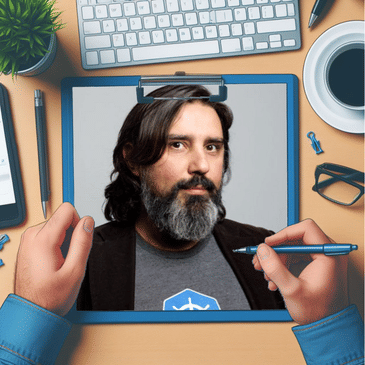
In this episode of simplyblock's Cloud Commute podcast, host Chris Engelbert welcomes Alessandro Vozza, a prominent figure in the Kubernetes and cloud-native community. Alessandro shares his journey from his early days in open-source advocacy to his pivotal role in organizing the DevOps and Kubernetes meetups in Amsterdam.
In this episode of Cloud Commute, Chris and Alessandro discuss:
- Kubernetes community engagement and CNCF ambassador role
- Developing namespace-as-a-service for Kubernetes platforms
- The future of Kubernetes: WebAssembly, AI, and environmental sustainability
- Building flexible, cloud-agnostic infrastructure for developers
Interested to learn more about the cloud infrastructure stack like storage, security, and Kubernetes? Head to our website (www.simplyblock.io/cloud-commute-podcast) for more episodes, and follow us on LinkedIn (www.linkedin.com/company/simplyblock-io). You can also check out the detailed show notes on Youtube (www.youtube.com/watch?v=5Y8XBTGSSig).
You can find Alessandro Vozza on X @bongo and Linkedin: /alessandrovozza.
About simplyblock:
Simplyblock is an intelligent database storage orchestrator for IO-intensive workloads in Kubernetes, including databases and analytics solutions. It uses smart NVMe caching to speed up read I/O latency and queries. A single system connects local NVMe disks, GP3 volumes, and S3 making it easier to handle storage capacity and performance. With the benefits of thin provisioning, storage tiering, and volume pooling, your database workloads get better performance at lower cost without changes to existing AWS infrastructure.
👉 Get started with simplyblock: https://www.simplyblock.io/buy-now
🏪 simplyblock AWS Marketplace: https://aws.amazon.com/marketplace/seller-profile?id=seller-fzdtuccq3edzm
01:00:00
Yeah, the complexity lies in the
01:00:01
operation, in the
01:00:02
upgrades, the security,
01:00:05
to properly secure a Kubernetes
01:00:06
class, it takes a PhD almost, so
01:00:08
there's a whole sort of
01:00:11
ecosystem that you can do to
01:00:13
secure a cluster. But in
01:00:16
Kubespaces, we
01:00:17
can take care of it,
01:00:18
we can make sure that the clusters
01:00:19
are secure and compliant, while
01:00:22
still offering the freedom to
01:00:26
the developers to deploy what
01:00:27
they need and they like.
01:00:32
You're listening to simplyblock's Cloud Commute Podcast,
01:00:35
your weekly 20 minute
01:00:36
podcast about cloud technologies,
01:00:37
Kubernetes, security,
01:00:39
sustainability, and more.
01:00:41
Hello, everyone. Welcome back to
01:00:42
the next episode of simplyblock's
01:00:44
Cloud Commute podcast. Today,
01:00:46
I have another incredible guest. I
01:00:48
know I say that every time, but
01:00:49
he's really incredible. He's
01:00:51
around in the Kubernetes space for
01:00:53
quite a while. And I think,
01:00:56
Alessandro, the best way is just
01:00:58
introduce yourself. Who are you?
01:01:00
What you've done in the past, and
01:01:02
what are you doing right now?
01:01:04
Thank you for having me. Well,
01:01:07
Alessandro, yes, indeed. I'm
01:01:09
being around for some time in the
01:01:12
cloud-native community. I'm Italian,
01:01:17
from the south of Italy, and I
01:01:18
moved to Amsterdam, where I live
01:01:20
currently about 20 years ago,
01:01:23
to get my PhD in chemistry. And
01:01:25
then after I finish my PhD, that's
01:01:29
my career. So I went through
01:01:31
different phases, always around
01:01:33
open source, of course. I've been
01:01:35
advocate for open source,
01:01:38
and an user of open source since the
01:01:40
beginning of my, since I could lay
01:01:43
my hands on a keyboard.
01:01:46
That led me to various places, of
01:01:49
course, and various projects. So I
01:01:51
started running the DevOps
01:01:53
meetup in Amsterdam back in the
01:01:56
day, 10, 11 years ago. Then from
01:01:59
there, I moved to the OpenStack,
01:02:00
project and running the OpenStack
01:02:02
community. And, but when I
01:02:05
discovered
01:02:05
Kubernetes, and what will
01:02:08
become the Cloud Native Computing
01:02:10
Foundation, I started running the
01:02:12
local meetup. And that
01:02:15
was kind of a turning point for
01:02:17
me. I really embraced the
01:02:19
community and embraced the project
01:02:21
and started working on the things.
01:02:23
So basically what I do is to
01:02:25
organize the meetup and organize
01:02:27
the KCDs, the Kubernetes Community
01:02:29
Days in Amsterdam, in Utrecht, in
01:02:32
the country. That kind
01:02:35
of led me through a natural
01:02:39
process to be a CNCF
01:02:42
Ambassador, which are
01:02:44
people that represent
01:02:47
or are so enthusiastic about the
01:02:50
way the Cloud Native Computing
01:02:51
Foundation works and the community
01:02:53
that are naturally elected to be
01:02:57
the face or the ambassadors for
01:03:00
the project, for the mission.
01:03:03
At this moment, I still do that.
01:03:05
It's my honor and pleasure to
01:03:07
serve the community, to create, to
01:03:10
to run monthly meetups and KCDs
01:03:13
and help other communities thrive
01:03:16
as well. So the lesson learned
01:03:19
in the Netherlands, in the meetups
01:03:21
and in the conferences, we try to
01:03:24
spread them as much as
01:03:25
possible. We are always available
01:03:26
for other communities to help them
01:03:31
thrive as well. So
01:03:32
that's been me in a nutshell. So all
01:03:35
about community. I always say I'm
01:03:39
an average programmer, I'm an
01:03:42
average engineer, but what I
01:03:44
really shine is to organize these
01:03:47
events and to get the
01:03:49
people together. I get the kick
01:03:51
out of a successful event where
01:03:54
people form connection and
01:03:57
grow together. So that's what
01:03:59
drives me in my very core. I like
01:04:03
how you put this.
01:04:05
You really shine in
01:04:07
bringing engagement to the
01:04:08
community, helping people to shine
01:04:10
themselves, to grow themselves.
01:04:12
I think that is a big part of
01:04:14
being a developer
01:04:15
advocate or in the developer
01:04:17
relations space in general. You
01:04:19
love this sharing of information,
01:04:21
helping other people to get the
01:04:24
most out of it.
01:04:27
Actually, I used be, or I still
01:04:32
do play the bass, electric bass
01:04:35
and double bass.
01:04:37
And the bass player
01:04:38
stays in the back next to the
01:04:40
drummer and he creates the
01:04:44
condition so the other
01:04:46
members of the band shine. So the
01:04:48
guitar player usually stays in
01:04:52
front, the bass player is the guy
01:04:54
that stays back and is happy to
01:04:56
create the foundations and cover
01:05:01
the music to really shine.
01:05:04
And that's maybe my nature. So
01:05:06
maybe it reflects from the fact
01:05:08
that I always
01:05:09
love playing the bass
01:05:11
and be that guy in a band.
01:05:14
I love that. That's a great analogy. I
01:05:17
never thought about that,
01:05:18
but that is just brilliant. And I
01:05:21
actually did the same thing in the
01:05:22
past, so there may be some
01:05:24
truth to that. So we met a few
01:05:29
weeks ago in Amsterdam, actually
01:05:31
at AWS Summit Amsterdam.
01:05:35
And I invited you because I
01:05:38
thought you're still with the
01:05:39
previous company, but you're doing
01:05:40
something new right now. So before
01:05:44
that, you were with
01:05:45
Solo.io, an API gateway,
01:05:49
networking, whatever kind of
01:05:51
thing. But you're doing your own
01:05:53
thing. So tell us about it.
01:05:56
Yeah. So it was a great year doing
01:05:59
DevRel and so much
01:06:02
fun going and speaking
01:06:05
service mesh, which is something
01:06:07
that I really
01:06:08
believe it's going to,
01:06:10
it's something that everybody
01:06:11
needs, but I know it's a
01:06:13
controversial, but
01:06:15
it's something that I really, you
01:06:17
got to believe in it. You know,
01:06:18
when you are a developer advocate,
01:06:20
when you represent a company or
01:06:22
community, the passion is
01:06:24
important. You cannot have passion
01:06:26
for something you don't believe
01:06:27
in, for something that you don't
01:06:30
completely embrace. And that was
01:06:33
great. And we had so much fun for
01:06:34
about a year or a bit more. But
01:06:36
then I decided that I'm too
01:06:39
young to settle, as always, like
01:06:41
I'm only 48, come on, I have a
01:06:44
good 10 years of engineering
01:06:48
work to do. So I decided that I
01:06:51
wanted to work on something else,
01:06:53
on something mine, more, more
01:06:55
mine, more, more an idea that I
01:06:57
had, and I want to see develop.
01:06:59
A gap in the market and a real
01:07:05
need for developers to have a
01:07:08
flexible environment,
01:07:10
environments to deploy their
01:07:12
applications. So fulfilling the
01:07:14
promises of platform engineering
01:07:17
as a self-service platform to
01:07:19
deploy applications. So the idea
01:07:21
goes around the
01:07:23
namespace. What is a
01:07:24
namespace? Of course, it's what
01:07:26
the unit of deployment in
01:07:29
Kubernetes really, it's this
01:07:32
magical place where developers can
01:07:35
be free and can deploy their
01:07:38
application without the
01:07:40
control within the guard rails of
01:07:43
whatever the system means, the
01:07:45
cluster administrator sets.
01:07:47
But developers really love
01:07:50
freedom. So developers don't want
01:07:52
to have to interact even with the
01:07:55
sysops or sysadmins. In fact,
01:07:58
developers love Heroku. So Heroku,
01:08:01
I think, is the hallmark of
01:08:03
developer experience where you
01:08:05
just can deploy whatever you want,
01:08:09
all your code, all your
01:08:10
applications in a place and it's
01:08:12
automatically exposed and you can
01:08:15
manage by yourself
01:08:17
everything about your application.
01:08:20
I want to reproduce that. I want
01:08:23
to get inspired by that
01:08:25
particular developer experience.
01:08:27
But because I love Kubernetes, of
01:08:30
course, and because I really
01:08:33
believe that the Kubernetes APIs
01:08:35
are the cornerstone, the golden
01:08:40
standards of
01:08:41
cloud-native application
01:08:43
deployment. So I want to offer the
01:08:47
same experience but
01:08:48
through the Kubernetes API.
01:08:50
So how you do that, and that's, of
01:08:52
course, like this evolving
01:08:54
product, me and a bunch of people
01:08:57
are still working on, define
01:08:59
exactly what does it mean and how
01:09:02
it's going to
01:09:03
work. But the idea is
01:09:04
that we offer namespace as a
01:09:06
service. What really matters to
01:09:08
developers is not
01:09:09
the clusters, is not
01:09:11
the VMs or the networks or all the
01:09:13
necessary evil that you need to
01:09:16
run namespaces. But what
01:09:18
really matters is the namespace,
01:09:19
is a place where they can deploy
01:09:22
their application. So what if we
01:09:24
could offer the best of both
01:09:26
worlds, kind of like the promises
01:09:30
of serverless computing, right? So
01:09:33
you are unburdened by
01:09:35
infrastructure. Of course, there
01:09:37
is infrastructure somewhere,
01:09:39
the cloud is just somebody else's
01:09:42
computer, right? So it's not in
01:09:43
magic, but it feels like magic
01:09:47
because the clever arrangement of
01:09:51
servers in a way that you don't
01:09:53
see them, but
01:09:54
they are still there.
01:09:56
So imagine a clusterless
01:09:57
Kubernetes. The experience of
01:09:59
Kubernetes, the API really,
01:10:01
so all the APIs that you learn to
01:10:05
love and embrace without the
01:10:09
burden of infrastructure.
01:10:10
So that's the core idea.
01:10:13
So that means it's slightly different from
01:10:15
those app platforms like
01:10:18
Fargate or what's the Azure and
01:10:22
GCP ones, CloudRun and whatever.
01:10:26
So it's slightly different,
01:10:28
right? Because you're still having
01:10:30
everything Kubernetes offers you.
01:10:32
You still have your CRDs
01:10:33
or your resource definitions, but
01:10:37
you don't have to manage
01:10:39
Kubernetes on its own because it's
01:10:41
basically a hosted platform. Is that correct?
01:10:44
Yeah. So those
01:10:45
platforms, of course, they are
01:10:47
meant to run in single individual
01:10:49
application pods, but they don't
01:10:53
feel like Kubernetes.
01:10:54
I don't understand. For me,
01:10:57
because I love it so much, I think
01:10:59
developers, I think we have a,
01:11:04
developers love to learn also new
01:11:07
things. So developers will love to
01:11:09
have a Kubernetes cluster
01:11:11
where they can do what they like,
01:11:13
but without the burden of managing
01:11:16
it. But this CloudRun and ACI
01:11:19
and Fargate, they are great tools,
01:11:21
of course, and you can use them to
01:11:24
put together some infrastructure,
01:11:27
but they're still limiting in what
01:11:30
you can deploy. So you can deploy
01:11:33
this single container, but it's
01:11:37
not a full fledged
01:11:39
Kubernetes cluster. And
01:11:42
I think it's still tripling in a
01:11:45
way that you don't have the full
01:11:47
API at your disposal,
01:11:49
but you have to go through this
01:11:51
extra API layer. It's a bespoke
01:11:54
API, so you got to
01:11:56
learn CloudRun,
01:11:57
you got to learn ACI, you got to
01:11:58
learn Fargate, but they are not
01:12:02
compatible to each other.
01:12:04
They are very cloud specific, but
01:12:09
a Kubernetes API is cloud
01:12:11
agnostic, and that's
01:12:12
what I want to build.
01:12:14
What we seek to build is to have a
01:12:16
single place where you can deploy
01:12:18
in every cloud, in every region,
01:12:21
in some multi region, multi Cloud,
01:12:23
but through the same API layer,
01:12:25
which is the pure and simple Kubernetes API.
01:12:29
I can see there's
01:12:31
two groups of people, the ones
01:12:33
that say, just hide all the
01:12:35
complexity from Kubernetes. And
01:12:37
you're kind of on the other side,
01:12:39
I wouldn't say going all the way,
01:12:42
like you want the complexity, but
01:12:44
you want the feature set, the
01:12:46
possibilities that Kubernetes
01:12:48
still offers you without the
01:12:50
complexity of operating it. That's my feeling.
01:12:53
Yeah, the complexity lies in the
01:12:55
operation, in the
01:12:56
upgrades, the security,
01:12:58
to properly secure a Kubernetes
01:12:59
class, it takes a PhD almost, so
01:13:02
there's a whole sort of
01:13:05
ecosystem that you can do to
01:13:06
secure a cluster. But in
01:13:10
Kubespaces, we
01:13:11
can take care of it,
01:13:12
we can make sure that the clusters
01:13:13
are secure and compliant, while
01:13:16
still offering the freedom to
01:13:19
the developers to deploy what they need and
01:13:21
they like. I think we
01:13:24
underestimate the
01:13:25
developers, so they
01:13:27
love to tinker with the platform,
01:13:34
so they love freedom, they don't
01:13:37
want the burden, even to
01:13:39
interact with the operation team.
01:13:41
And so the very proposal here is
01:13:43
that you don't need an operation
01:13:45
team, you don't need a platform
01:13:46
engineering team, it's all part of
01:13:48
the platform that we offer.
01:13:50
And you don't even need an account
01:13:52
in Azure or AWS, you can select
01:13:55
which cloud and which
01:13:59
region to deploy to completely
01:14:01
seamlessly and without limits.
01:14:06
Okay, so that means
01:14:07
you can select, okay, I need a
01:14:09
Kubernetes cluster namespace,
01:14:11
whatever you want
01:14:12
to call it, in Azure,
01:14:14
in Frankfurt or in Western Europe,
01:14:16
whatever they call it. Okay, so.
01:14:19
Yeah, it is still a thing,
01:14:23
so people don't want to be in
01:14:24
clouds that don't trust, so if you
01:14:27
don't want to be in Azure,
01:14:28
you should not be forced to. So we
01:14:32
offer several infrastructure
01:14:34
pieces, clusters, even if the word
01:14:37
cluster doesn't even here
01:14:40
anywhere, because it's by design,
01:14:42
we don't want people to think
01:14:44
in terms of clusters, we want
01:14:46
people to think in terms of
01:14:47
namespaces and
01:14:49
specifically tenants,
01:14:50
which are just a collection of
01:14:51
namespaces, right? So it's a one
01:14:54
namespace is not going to cut it,
01:14:56
of course, you want to have
01:14:57
multiple to assign to your teams,
01:15:00
to group them in environments like
01:15:02
that, prod or test, and then
01:15:05
assign them to your team, to your
01:15:07
teams, so they can deploy and
01:15:10
they're fun with their namespaces and tenants.
01:15:13
Yeah, I think there's
01:15:15
one other thing which is
01:15:16
also important when you select a
01:15:18
cloud and stuff, you may have
01:15:19
other applications
01:15:20
or other services
01:15:21
already in place, and you just
01:15:23
want to make sure that you have
01:15:24
the lowest latency, you don't have
01:15:26
to pay for throughput, and stuff
01:15:28
like that. Something that I always
01:15:30
find complicated with
01:15:31
hosted database platforms, to be
01:15:33
honest, because you have to have
01:15:35
them in the same region somehow.
01:15:38
Yeah, that's also political
01:15:40
reason, right? Or commercial
01:15:42
reason that prevents you from that.
01:15:43
Fair, fair. They're supposed to be
01:15:47
people that love
01:15:47
Microsoft for everything.
01:15:51
I love Microsoft, of course, been
01:15:53
there for seven years. I'm not a
01:15:55
fanboy, maybe I am a little, but
01:15:57
that's all right.
01:16:02
Everybody, that's why the world is
01:16:04
a beautiful place. Everybody is
01:16:06
entitled to ease of their opinion,
01:16:08
and that's all right.
01:16:10
I think Microsoft did a great job with the
01:16:13
cloud, and in general, a lot of
01:16:16
the changes they did over the last
01:16:17
couple of decades, like the last
01:16:19
two decades, I think there are
01:16:20
still the teams like the Office
01:16:21
and the Windows team, which are
01:16:23
probably very enterprise-y still,
01:16:24
but all of the other ones. For me
01:16:27
specifically, the Java team at
01:16:28
Microsoft, they're all doing a
01:16:30
great job, and they seem to be
01:16:32
much easier and
01:16:34
much more community
01:16:35
driven than the others.
01:16:37
I was so lucky because I was there, so I
01:16:41
saw it with my own eyes,
01:16:44
the unfolding of this war machine
01:16:47
of Microsoft. There was this
01:16:49
tension of beating Amazon at
01:16:52
their own game. Seven years ago,
01:16:56
we had this mission of really,
01:16:58
really demonstrating that
01:17:00
Microsoft was serious about open
01:17:02
source, about cloud, and it paid
01:17:05
off, and they definitely
01:17:09
put Microsoft back on the map. I'm
01:17:13
proud and very, very grateful to
01:17:16
be here. You have been there,
01:17:18
Microsoft joining the Linux
01:17:19
Foundation, the Cloud Native
01:17:20
Computing Foundation really
01:17:22
being serious about
01:17:23
Cloud Native, and now it works. I
01:17:29
agree. The Post-Balmer era is
01:17:32
definitely a different
01:17:34
world for Microsoft. All right,
01:17:35
let's get back to Kubespaces,
01:17:38
because looking at the time, we're
01:17:39
at 17. You said it's, I think it's
01:17:47
a shared resource. You see the
01:17:48
Kubernetes as a multi-tenant
01:17:50
application, so how does isolation
01:17:52
work between customers? Because I
01:17:54
think that is probably a good
01:17:56
question for a lot of
01:17:57
security-concerned people.
01:17:59
Yeah, so of course, in the first
01:18:01
iteration would
01:18:02
be a pure play SaaS where
01:18:05
you have shared tenants. I mean, it's an
01:18:08
infrastructure share among
01:18:09
customers. That's
01:18:11
by design the first iteration.
01:18:13
There will be more, probably where
01:18:14
we can offer dedicated clusters to
01:18:18
specific customers. But in the
01:18:21
beginning, it will be based on a
01:18:23
mix of technologies between big
01:18:24
cluster and fireecracker, which
01:18:27
ensure better isolation of your
01:18:31
workload. So it is indeed one
01:18:34
piece of infrastructure where you
01:18:35
can, where multiple customers will
01:18:38
throw their application,
01:18:39
but you won't be able to see each
01:18:41
other. Everybody gets his own API
01:18:44
endpoint for Kubernetes API,
01:18:46
so you will not be able. RBAC
01:18:50
is great, and it
01:18:51
works, of course, and it's
01:18:52
an arcane magic thing and it's
01:18:57
arcane knowledge. Of course, to
01:18:58
properly do RBAC is quite
01:19:00
difficult. So instead of risking
01:19:03
to make a mistake in some cluster
01:19:07
role or role, and then
01:19:09
everybody can see everything, you
01:19:11
better have isolation between
01:19:13
tenants. And that comes with
01:19:16
a popular project like big
01:19:17
cluster, which has been already
01:19:21
around for five years. So that's
01:19:23
some knowledge there already. And
01:19:27
even an other layer of isolation,
01:19:30
things like katacontainer
01:19:32
and firecracker, they provide
01:19:34
much better isolation at the
01:19:37
container runtime level.
01:19:39
So even if you escape from the
01:19:42
container, from the jail of the
01:19:45
container, you only can see
01:19:46
very limited view of the world and
01:19:48
you cannot see the rest of the
01:19:50
infrastructure. So that's the idea
01:19:53
of isolating workloads between
01:19:57
customers. You could find, of
01:20:00
course, flaws in
01:20:01
it, but we will take
01:20:03
care of it and we will have all
01:20:04
the monitoring in place to do. To
01:20:07
prevent it, it's a
01:20:09
learning experience.
01:20:10
We want to prove to ourselves
01:20:14
first and to
01:20:15
customers that we can do this.
01:20:17
Right. Okay. For the sake of time,
01:20:21
a very, very... Well, I think
01:20:24
because you're still building this
01:20:26
thing out, it may be very
01:20:28
interesting for you to talk about
01:20:29
that. I think right
01:20:30
now it's most like
01:20:31
a one person thing. So if you're
01:20:35
looking for somebody to help with
01:20:37
that, now is your time to ask for people.
01:20:39
Yeah. If the ideas
01:20:41
resonate and you want to build a
01:20:42
product together,
01:20:45
I do need backend engineers,
01:20:47
front-end engineers, or just
01:20:49
enthusiastic people
01:20:50
that believe in idea.
01:20:52
It's my first shot at building a
01:20:54
product or building a startup. Of
01:20:55
course, I've been building
01:20:57
other businesses before,
01:21:00
consulting and even a coworking
01:21:02
space called Cloud Pirates.
01:21:05
But now I want to take a shot at
01:21:08
building a product and see how it
01:21:11
goes. The idea is sound.
01:21:13
There's some real need in the
01:21:17
market. So it's just a matter of
01:21:18
building it, build something that
01:21:22
people want. So don't start from
01:21:24
your ideas, but just listen to
01:21:26
what people tell you to build
01:21:29
and see how it goes. So yeah, I'll
01:21:33
be very happy to talk about it and
01:21:35
to accept other people's ideas.
01:21:38
Perfect. Last question, something
01:21:40
I always have to ask people. What
01:21:42
do you think will be the next
01:21:44
big thing in Kubernetes? Is it the
01:21:46
namespace as a service or do you
01:21:48
see anything else as well?
01:21:49
If I knew, of course, in the last
01:21:56
KubeCon in Paris, of course,
01:21:59
the trends are clear, this AI,
01:22:02
this feeding into AI, but also
01:22:05
helping AI thrive from Cloud
01:22:08
Native. So this
01:22:09
dual relationship with
01:22:11
the Gen AI and the new trends in
01:22:14
computing, which is very
01:22:16
important. But of
01:22:17
course, if you ask people,
01:22:18
there will be WebAssembly on the
01:22:20
horizon, not replacing containers,
01:22:23
but definitely become a
01:22:25
thing. And so there are trends.
01:22:30
And that's great about this
01:22:31
community and this
01:22:32
technologist that
01:22:34
is never boring. So there's always
01:22:36
something new to learn. And I'm
01:22:38
personally trying to learn every
01:22:40
day. And if it's not WebAssembly,
01:22:42
it's something else, but trying to
01:22:46
stay updated. This is fun.
01:22:49
And challenge your convention,
01:22:52
your knowledge every day. So this
01:22:54
idea from Microsoft that I
01:22:56
learned about growth mindset, what
01:22:59
you should know now is never
01:23:01
enough if you think ahead. And
01:23:05
it's a beautiful thing to see. So
01:23:08
it's something that keeps me every
01:23:12
day. Now I'm learning a lot of
01:23:14
on-premise as well. These are also
01:23:16
trying to move workloads back to
01:23:19
the data centers. There are
01:23:22
reasons for it. And one trend is
01:23:24
actually one very important one.
01:23:26
And I want to shout out to the
01:23:28
people in the Netherlands also
01:23:30
working on it is green computing
01:23:32
or environmental sustainability
01:23:34
of software and infrastructure. So
01:23:37
within the CNCF, there is the
01:23:39
Technical Advisory Group
01:23:41
environmental sustainability,
01:23:42
which we're collaborating with. We
01:23:44
are running the environmental
01:23:46
sustainability week in October. So
01:23:49
worldwide events all around
01:23:51
getting the
01:23:54
software we all love and
01:23:56
care to run greener and leaner and
01:23:59
less carbon intense. And this is
01:24:03
not just our community,
01:24:07
but it's the old planet involved.
01:24:09
Or at least should be concerned
01:24:11
for everybody concerned about
01:24:13
the future of us. And I mean, I
01:24:17
have a few kids, so I have five
01:24:20
kids. So it's
01:24:21
something that concerns
01:24:22
me a lot to leave a better place
01:24:25
than I found it.
01:24:26
I think that is a
01:24:28
beautiful last statement,
01:24:30
because we're running out of time.
01:24:31
But in case you haven't seen the
01:24:33
first episode of a podcast,
01:24:35
that may be something for you
01:24:36
because we actually talked to Rich
01:24:38
Kenny from Interact and they work
01:24:44
on data center sustainability,
01:24:45
kind of doing the same thing on a
01:24:47
hardware level. Really, really
01:24:48
interesting stuff. All right.
01:24:50
Thank you very much. It was a
01:24:52
pleasure having you.
01:24:55
And for the audience,
01:24:57
next week, same time, same place.
01:25:01
And I hope you're
01:25:02
listening again. Thank you.
01:25:04
Thank you so much for having me.
01:25:06
You're welcome.
01:25:08
The cloud commute podcast is sponsored by
01:25:10
simplyblock your own elastic
01:25:12
block storage engine for the cloud.
01:25:14
Get higher IOPS and low predictable
01:25:15
latency while bringing down your
01:25:17
total cost of ownership.
01:25:18
www.simplyblock.io